Blog

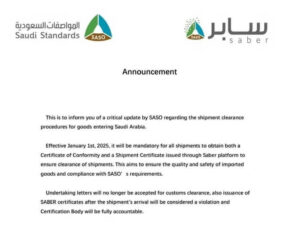
Saber Certification for Toys – Complete Guide Saber certification is mandatory for entering the Saudi market. For toys, which fall under the GCC Technical Regulation for children's products, the full certification process consists of two main steps: Apply for a PC Certificate and then Apply for an SC Certificate. Core Certification Process: Two Steps Before starting, ensure your Saudi importer has a valid account on the Saber platform – this is required for all applications. Step & CertificateKey ActionsRequired DocumentsValidityEstimated TurnaroundStep 1: Apply for PC Certificate(Product Conformity Certificate)Importer submits application via Saber platform. Approved by an authorized certification body.- GCC certificate & test reports- Product images & labels- Manufacturer's ISO 9001 certificate- Signed Declaration of Conformity1 yearRenewable. Re-application required if importer changes or product models change.Typically 3-7 working daysStep 2: Apply for SC Certificate(Shipment Conformity Certificate)Before each shipment, importer uploads final commercial invoice and packing list, links a valid PC certificate, and applies for SC.- Valid PC certificate- Commercial invoice- Packing listSingle shipment only1-2 working days after submission All applications, payments, and certificate issuances are done online via the Saber platform. No need to print paper certificates. Note: For toys, a valid GCC certificate is required before applying for the PC certificate. Key Policy Updates (2025) Full Mandatory Enforcement: From 1 January 2025, all shipments must obtain PCoC and SCoC via the Saber system. Letters of undertaking (LoU) are no longer accepted for customs clearance. High-Risk Product Rules & Shorter Test Report Validity: Children's toys are classified as high-risk products and subject...

Saudi Saber Certification
2026-04-29

SABER Certification for Home Appliances – Exports to Saudi Arabia According to the latest requirements from the Saudi Standards, Metrology and Quality Organization (SASO) effective from January 1, 2025, all regulated products (including home appliances) exported to Saudi Arabia must obtain certification through the SABER system to clear customs successfully. The core function of the SABER platform is to issue electronic certificates required for customs clearance online. To obtain these certificates, the application must be initiated by a locally registered company in Saudi Arabia (the Saudi importer). Exporters themselves cannot apply directly. The certification process consists of two main steps, resulting in two types of certificates: PC Certificate (Product Certificate of Conformity): This is the market access permit for each product model in Saudi Arabia. It is usually valid for one year and can be used for multiple shipments. SC Certificate (Shipment Certificate of Conformity): This is the “customs clearance pass” for each shipment. One certificate per shipment. It must be applied for before the cargo arrives at the port; otherwise, clearance will be impossible. Certification paths for home appliances exported to Saudi Arabia SABER certification is not a standalone test but an integrated platform. For home appliances, obtaining a PC certificate on SABER usually requires first securing other core certifications. Depending on the type of appliance, the main certification paths are as follows: Product / Certification TypeCommon ExamplesKey Certification Path & NotesHigh-energy appliances – Energy Efficiency (EER) certificationRefrigerators, air conditioners, washing machines, dishwashersThis is the first and most...

Saudi Saber Certification
2026-04-29

SABER certification is a mandatory compliance requirement for automotive spare parts exported to the Saudi market. Below is a systematic overview covering certification system basics, applicable product scope, requirements, detailed process, document preparation, costs, timelines, and practical recommendations. 1. What is SABER Certification? SABER (Saudi Product Conformity Certificate) is a mandatory electronic customs clearance system launched in 2019 by the Saudi Standards, Metrology and Quality Organization (SASO). It replaced the old SASO COC certification and aims to ensure imported products comply with Saudi technical regulations. To understand SABER, it is important to distinguish the roles: SASO is the government body that sets standards and issues Technical Regulations (TR), while SABER is the electronic platform that enforces these regulations – handling product registration, review, certificate issuance, and data integration with Saudi Customs. As of January 1, 2025, all goods exported to Saudi Arabia must obtain both PC and SC certificates through the SABER system. The old "letter of commitment" clearance method has been completely abolished. Furthermore, SC certificates applied for after the goods have arrived at port will be considered invalid – resulting in customs clearance failure, possible fines, demurrage, and other additional costs. 2. Scope of SABER Certification for Automotive Spare Parts Automotive spare parts fall under mandatory SABER certification. According to current Saudi regulations, the following automotive-related products require SABER certification: CategoryExamplesAutomotive safety componentsSafety glass, braking systems, lighting components, seat beltsWear partsTires, wiper blades, rearview mirrorsElectrical partsBatteries (including lithium batteries, car batteries)Complete vehicles & commercial vehiclesTrucks, trailers, semi-trailers (may require...

Saudi Saber Certification
2026-04-28